

Ecommerce
Ecommerce website development that actually checks out
If the cart dies on mobile, the theme was free and the revenue is not. We build ecommerce websites around catalog reality: variants, shipping, taxes, and a checkout people finish. The storefront is a sales channel with ops behind it — not a marketing microsite with a Buy button taped on.

Checkout is the product. The theme was never the brief.
If the cart dies on a phone, the theme was free and the revenue is not. Ecommerce website development at CodeLoop Studio is catalog, cart, checkout, payments, and an admin your team can run after launch day — not a marketing microsite with a Buy button taped on.
We pick a stack after we see SKU count, variants, and which payment and fulfillment tools you already pay for. Collection pages are written to rank, not empty filter dumps. Costs stay visible on a thumb. Digital goods, appointments sold as products, and physical inventory are different problems; we do not pretend one theme covers all three.
If you only need a brochure and a contact form, website development is the cheaper honest path. If checkout is the product, stay here. If the catalog is really an operations system — pricing rules, portals, warehouse — that leans toward custom software. Studio in Sarajevo. Remote by default. A scoped number after we see SKU reality, usually within 24 hours of a useful brief via the online estimate.
Shopify stays if it still fits. Custom when the theme is the enemy.
We pick a stack after SKU count, variants, and which payment and fulfillment tools you already pay for. Some shops should stay on Shopify with a better theme and apps. Some need a custom storefront because the variant matrix, pricing rules, or brand cannot live inside a skin. Collection pages are written to rank, not empty filter dumps. Costs stay visible on a phone thumb. Digital goods, appointments sold as products, and physical inventory are different problems; we do not pretend one theme covers all three.
Merchandisers must edit without a developer ticket. Finance needs the processor they already reconciled — cards, wallets, local methods when the market requires them. The constraint is usually payout setup, not our favourite logo. Analytics on funnel steps, not only homepage vanity. Go-live includes tax, shipping, and failed-payment states. Peak-season hardening is a later conversation once the path works.
DigitalPlay is a games and digital-products webshop: product grid, cart, and checkout that stay clear on a phone. A brand, not a generic template. A focused catalog with a clean checkout is often a few months. Large variant matrices, custom pricing, or warehouse integrations take longer. If you only need a brochure and a contact form, website development is cheaper and honest. If the catalog is really operations software, that leans toward custom software. Studio in Sarajevo. Remote by default.
What has to work before we talk about a theme
How a shopper finds a SKU
Search, collection, or a campaign landing. If they cannot find it on a phone, the rest of the stack is decoration.
Variants that match the warehouse
Size, colour, license, duration. A matrix the theme cannot express is why custom storefronts exist.
Visible costs on a thumb
Shipping, tax, fees before the last step. Surprise totals are how carts die.
The processor finance already uses
Cards, wallets, local methods when the market requires them. We wire payouts you can reconcile — not our favourite logo.
Merchandisers without tickets
Price and stock changes in admin. If an engineer is required to hide a SKU, we missed the ops requirement.
Failed-payment and empty states
Launch is not a happy path. Declined cards, out-of-stock, and emails that actually send sit on the go-live list.
How we ship a storefront that completes the purchase
- 01
Audit the catalog, not the moodboard
SKU count, variants, current stack, what the theme already fights. Shopify stays if it still fits; custom when it does not.
- 02
Freeze find → pay
The shopper path first. Collection SEO and internals belong here, not as a plugin after launch.
- 03
Wire ops
Inventory, emails, tax, shipping. Analytics on funnel steps, not only homepage vanity.
- 04
Staging and a go-live checklist
Named owner. Failed payments, empty collections, mobile thumbs. Peak-season hardening is a later conversation once the path works.
- 05
Stay for merchandising
New collections, campaign landings, the next payment method. Handover is documentation, not a vanished vendor.
Case study
DigitalPlay
A games and digital-products webshop: product grid, cart, and checkout that stay clear on a phone. A brand, not a generic template, with a purchase path first-time visitors can complete.
What to send so the estimate is not fiction
Catalog size and variant reality
A number, and whether SKUs fight the current theme. Screenshots of the worst product page help more than a brand deck.
How you take money today
Processor, payout country, digital vs physical. Finance constraints beat our stack preference.
Who edits after launch
Merchandisers, not engineers. Send it through the estimate form.
Frequently asked
Related
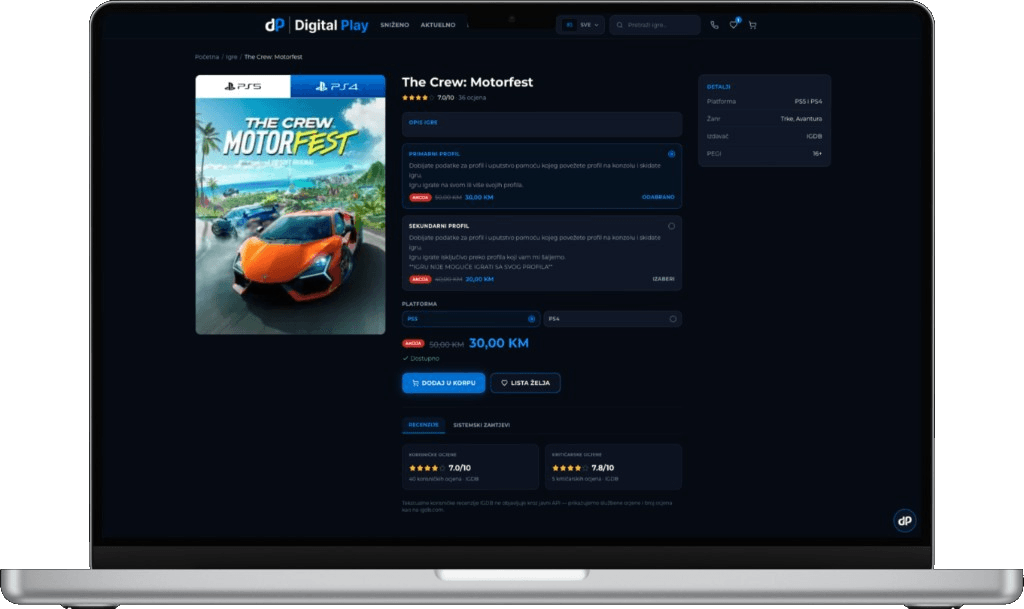
DigitalPlay case study
Webshop for games and digital play products — catalog, checkout, and storefront experience built end-to-end for the client.

Website development
CodeLoop Studio does web development in Sarajevo: marketing sites, booking flows, and product pages that load on a phone and convert. We write in English and Bosnian. Buyers are often in the US, UK, and EU; the named team sits on Dobrinja. This is the website brief — not an app-store binary, and not a logged-in dashboard.

Custom software
Off-the-shelf software stops at your actual process. We are a custom software development agency: MVPs, client portals, internal tools, and AI features that sit inside a real product — built by a studio in Sarajevo that works in English with US and European teams. This is systems work, not a marketing homepage and not a single-platform mobile sprint.
Ecommerce checkout (blog)
Ecommerce is variants, shipping, tax, and a checkout thumbs can finish. A Buy button on a brochure is not a shop.

What a web shop is (blog)
A web shop is the path from product to paid order. A gallery with a Buy button that opens chat is still a brochure — and you should budget it as one.

How we build a web shop (blog)
We start a web shop with how money and parcels move, not with a theme that dies on the first discount. SKU count and checkout rules freeze before the palette.

Custom mobile apps
You need a custom mobile app that can pass App Store and Google Play review, survive the next OS release, and get used more than once. CodeLoop Studio designs and builds native and cross-platform apps for startups and companies that want a product team, not a pile of screenshots. Stack choice comes after we see the product — this page is how we engage, staff, and ship.