
Blog · Cross-platform
Cross-Platform Mobile Apps with Flutter vs React Native
CodeLoop Studio · · Updated
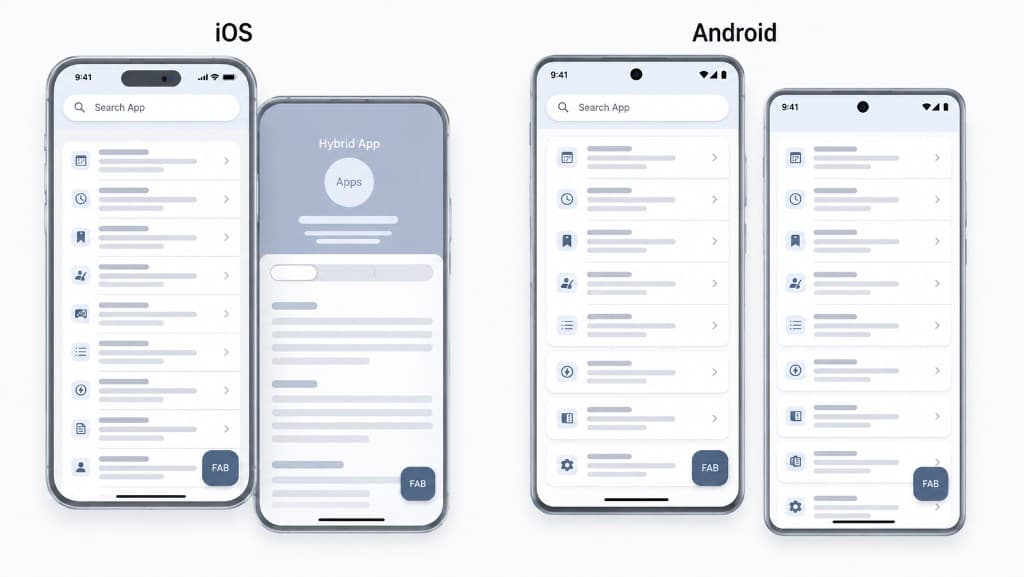
If you want to ship your mobile application on both iOS and Android without building two completely separate codebases, you'll quickly arrive at the question: Flutter or React Native? At CodeLoop Studio we work with both technologies and help clients choose the stack that fits their product, team, and long‑term roadmap.
In this guide we look at the key differences between Flutter and React Native for cross‑platform mobile app development – performance, user experience, developer experience, ecosystem, and long‑term maintenance. If you already know you need a product squad rather than a framework debate, start with our custom mobile app development overview, or the service pages for Flutter and React Native — this post is the comparison; those pages are the offer.
Quick overview of Flutter and React Native
Flutter is Google's UI toolkit based on the Dart language. It compiles to native ARM code, ships its own rendering engine, and offers a very consistent UI across platforms. Flutter is often chosen when product teams want pixel‑perfect, highly branded interfaces that look nearly identical on iOS and Android.
React Native is a JavaScript/TypeScript framework from Meta that lets you build native apps using React. It bridges your React components to native iOS and Android views. React Native is a natural fit for teams that already use React or Next.js on the web and want to reuse skills and patterns.
Performance and native user experience
For many mobile applications, both Flutter and React Native can deliver excellent performance and smooth animations. The differences become visible at the edges:
Flutter performance. Because Flutter controls every pixel on the screen with its own rendering engine, it can feel very smooth for custom UIs, charts, and complex motion. You're less dependent on platform‑specific UI components, which reduces inconsistencies between iOS and Android.
React Native performance. React Native relies on native components, which is great for platform‑specific UX and accessibility, but very heavy screens with lots of bridge calls may require extra optimisation. With proper architecture and modern libraries, React Native apps can still feel extremely fast.
In practice, architecture and implementation quality matter more than the framework. At CodeLoop Studio we focus on clean state management, efficient network calls, and performance profiling regardless of whether we use Flutter or React Native.
Developer experience and team skills
Your current team skills often matter more than any benchmark. If you already have a strong React / TypeScript team, React Native is usually the most natural path. Your developers can reuse patterns, share parts of the codebase, and move faster across web and mobile.
If you're building a greenfield mobile team and want a very consistent UI system with a single way of building interfaces, Flutter can be a great fit. Flutter's widget model and composition system are very productive once the team is past the initial learning curve.
When we recommend Flutter
Highly branded UI where you want full control over every pixel and animation.
Same look & feel across iOS, Android, and potentially web or desktop in the future.
Teams that are comfortable adopting Dart and Flutter's widget‑based architecture.
Products that benefit from very rapid UI iteration with hot‑reload and a single design system.
When we recommend React Native
You already use React or Next.js on the web and want to share knowledge and architectural patterns.
You want your app to feel very close to native iOS / Android patterns and controls.
You value access to a large JavaScript ecosystem, libraries, and community support.
You plan to integrate tightly with an existing web product or design system built in React.
Choosing the right stack for your product
There is no universal winner in the Flutter vs React Native debate. The right technology for your cross‑platform mobile app depends on your business goals, product roadmap, team skills, and technical constraints such as offline requirements or specific native integrations.
At CodeLoop Studio we evaluate these factors together with you and propose a stack—native Swift/Kotlin, React Native, or Flutter—that gives you the right balance of speed, cost, and long‑term maintainability. For a health-and-nutrition product like LipoDIETA, the stack decision followed the workflow, not a framework fashion cycle.
If you're considering a cross‑platform mobile app and aren't sure which framework is the best fit, get in touch with us and we'll walk you through the options, share real project examples, and help you make a confident decision.